
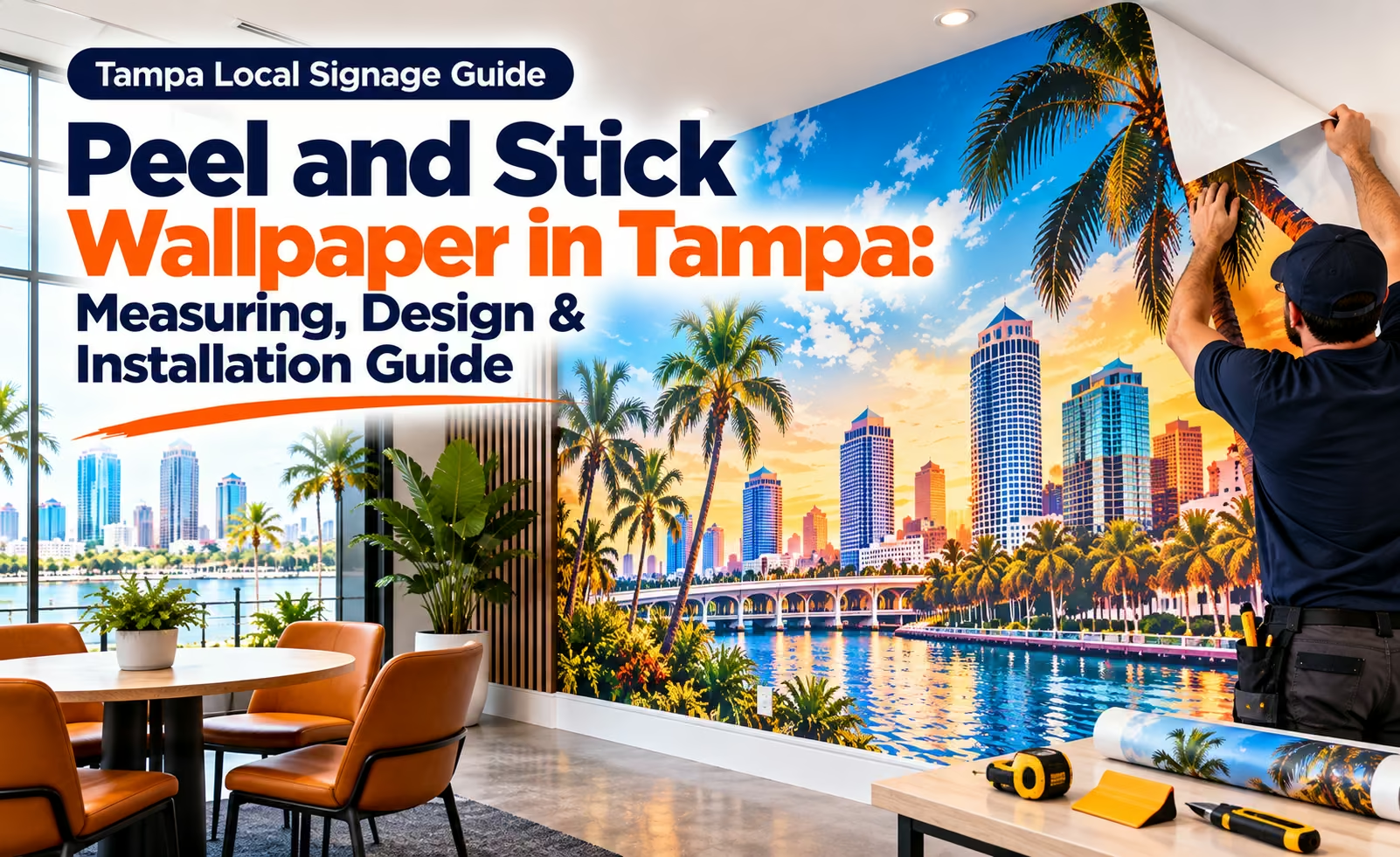
Tampa Peel & Stick Wallpaper Guide
Peel and Stick Wallpaper in Tampa: Measuring, Design & Installation Guide
Peel and stick wallpaper is a self-adhesive wall covering that can add color, patterns, photography or custom graphics to compatible interior walls without traditional wallpaper paste.
It can be useful for accent walls, offices, apartments, retail interiors, bedrooms, reception areas and temporary décor projects when the wall surface and adhesive system are suitable.
The finished result depends on more than the artwork. Wall condition, paint, measurements, panel layout, pattern alignment and installation technique can all affect how the wallpaper looks and performs.
This guide explains how to plan a peel and stick wallpaper project in Tampa, from measuring and artwork preparation to surface testing, installation and future removal.
Wallpaper Basics
What Is Peel and Stick Wallpaper?
Peel and stick wallpaper is a printed wall-covering material with adhesive already applied to the back.
Instead of applying separate wallpaper paste, the backing liner is removed and the material is positioned directly onto a compatible prepared wall.
Adhesive
Self-Adhesive Backing
The adhesive is built into the wall-covering material, so a separate paste application is not normally required for that product type.
Design
Custom Printed Graphics
Wallpaper can use patterns, illustrations, photography, colors, textures or branded artwork depending on the printing material and project.
Panels
Large Walls Use Sections
Wide walls are commonly divided into coordinated vertical panels that are installed in sequence to create the complete design.
“Peel and Stick” Does Not Automatically Mean Damage-Free
Removal performance depends on the adhesive, wall paint, surface condition, installation duration, humidity and how the material is removed.
A product described as removable should not be treated as a guarantee that every painted wall will remain unchanged.
If the property is rented or future removal is important, confirm the material specifications, review the lease requirements and test a small area before covering the full wall.
Surface Compatibility
What Walls Work Best With Peel and Stick Wallpaper?
Smooth, clean and stable surfaces generally give adhesive wall coverings the best opportunity to bond evenly.
Smooth Painted Drywall
A clean, properly cured and stable painted wall is usually easier to work with than a heavily textured or deteriorating surface.
Low-Texture Walls
Very light texture may work with some adhesive systems, but surface contact is reduced compared with a smooth wall.
Glass or Smooth Panels
Certain self-adhesive graphic materials can work on compatible smooth surfaces, although the selected material should be confirmed for that application.
Problem Surfaces
When Peel and Stick Wallpaper May Not Be the Best Choice
The wall surface should be inspected before choosing an adhesive covering.
- Heavily textured walls
- Loose or peeling paint
- Powdery or chalky surfaces
- Walls with moisture problems
- Fresh paint that has not fully cured
- Dirty, greasy or dusty surfaces
- Damaged drywall or unstable wall finishes
- Surfaces that are incompatible with the selected adhesive
Paint Condition
Why Wall Paint Matters
The adhesive attaches to the paint layer, not directly to the structure behind it.
If the paint is weak, poorly bonded or still curing, the wallpaper may lift prematurely or the paint may release when the graphic is removed.
Recently Painted Walls
Allow new paint to cure according to the paint manufacturer’s recommendations and the requirements of the selected adhesive material before installation.
Older Painted Walls
Inspect for peeling, bubbling, cracking, chalking or contamination before applying a large adhesive graphic.
Test the Actual Wall Before a Large Installation
When surface compatibility or future removal is important, a small material test can provide useful information before committing to the complete wall.
Place the test in an inconspicuous area and follow the relevant material guidance for testing time and removal.
Measuring
How to Measure a Wall for Peel and Stick Wallpaper
Accurate measurements are essential because the final graphic must cover the intended wall while allowing for trimming and installation.
- Measure the full wall width
- Measure the wall height in several locations
- Record doors and windows
- Measure around cabinets and built-in features
- Mark outlets and switches
- Identify trim, baseboards and crown molding
- Photograph the complete wall straight on
- Confirm which section of the wall will actually receive graphics
Wall Variations
Do Not Assume the Wall Is Perfectly Square
Walls, ceilings and floors may not be perfectly level or parallel.
Measuring only one point can create problems when the wallpaper reaches the opposite side of the installation.
Measure Left
Record the height near the left side of the planned wallpaper area.
Measure Center
Take another height measurement around the center of the wall.
Measure Right
Measure near the opposite side and plan artwork around the largest required dimension.
Panel Planning
Why Peel and Stick Wallpaper Is Often Printed in Panels
A large wall is normally wider than a practical single strip of printable wall covering.
The design can therefore be divided into multiple coordinated panels that together form one continuous image or pattern.
Panel Width
The exact width depends on the printable material, production equipment and installation plan.
Panel Sequence
Each panel should be clearly identified so the installer knows the correct left-to-right or right-to-left installation order.
Image Continuity
Photography, illustrations and patterns should align correctly where adjacent panels meet.
Seams
Plan Wallpaper Seams Around Important Artwork
Panel transitions are part of many large wallpaper installations.
When possible, avoid placing important faces, small typography, QR codes, logos or other fine details directly across a seam.
- Review the complete wall layout before paneling
- Keep important faces away from seams when practical
- Avoid splitting small logos across panels
- Check pattern continuity
- Keep important text inside clear areas
- Confirm whether panels overlap or meet edge-to-edge for the selected system
Pattern Wallpaper
How Pattern Repeats Affect Wallpaper Planning
Repeating wallpaper designs need more planning than a simple solid-color wall covering.
The repeat distance determines where one copy of the pattern needs to align with the next.
Small Repeat
Compact patterns repeat frequently and can create a consistent texture across the wall.
Large Repeat
Large geometric, botanical or decorative patterns may require more careful alignment across adjacent panels.
Custom Repeat
A custom pattern can be built specifically around the wall dimensions when the artwork and production setup support it.
Custom Artwork
What Can You Print on Custom Peel and Stick Wallpaper?
Patterns
Create geometric, botanical, abstract or decorative repeating artwork for residential or commercial interiors.
Photography
Use high-resolution landscapes, city imagery, architectural photography or custom photographs when image quality supports the finished dimensions.
Illustrations
Custom illustrations can create themed walls for offices, studios, children’s areas and creative interiors.
Brand Graphics
Businesses can combine logos, colors, shapes and branded design elements across a feature wall.
Textures
Printed artwork can visually reproduce materials such as stone, wood, concrete or other textures without actually changing the wall construction.
Custom Color Designs
Use artwork built around the room’s furniture, flooring, lighting and existing brand or interior color palette.
Image Quality
Use High-Resolution Artwork for Full-Wall Printing
Wallpaper may cover a much larger area than a poster or standard print, so small images can become visibly soft or pixelated when enlarged.
Use Original Files
Start with the highest-resolution original photograph or illustration instead of downloading a compressed copy from social media or a website.
Use Vector Graphics
Logos, typography and geometric graphics are easier to scale cleanly when the original artwork is vector-based.
Review at Finished Size
Artwork quality should be evaluated based on the final wall dimensions and intended viewing distance.
A Large Wall Cannot Fix a Small Image
Increasing the physical print size does not create additional photographic detail.
If the source artwork is too small, consider another image, redesign the composition or use graphical elements that can scale cleanly.
Room Planning
Design Wallpaper Around the Entire Room
Wallpaper should work with the surrounding interior rather than being designed as an isolated rectangle.
- Consider furniture placement
- Coordinate with flooring and trim
- Check natural and artificial lighting
- Keep important artwork away from shelving
- Plan around televisions and wall-mounted equipment
- Account for doors and windows
- Consider where people normally enter the room
- Choose a design scale appropriate for the viewing distance
Popular Applications
Where Peel and Stick Wallpaper Can Be Used
Bedrooms
Create an accent wall using patterns, abstract graphics, photography or custom decorative artwork.
Home Offices
Use custom backgrounds, patterns or branded graphics to give a workspace a more intentional visual identity.
Reception Areas
Businesses can use decorative or branded wallpaper behind reception counters and customer-facing areas.
Retail Interiors
Create temporary visual merchandising, branded feature walls or seasonal interior graphics when the selected surface and material are suitable.
Restaurants & Cafés
Use patterns, photography or branded graphics to support an interior theme on compatible walls.
Creative Studios
Create custom backgrounds for photography, videos, work areas or customer-facing spaces.
Rental Properties
Is Peel and Stick Wallpaper Good for Renters?
Peel and stick wallpaper is often considered for rental properties because some products are designed for easier removal than traditional pasted wall coverings.
However, renters should not assume every self-adhesive wallpaper will remove without affecting the paint.
- Review the lease before modifying walls
- Ask the property owner when approval is required
- Confirm the material is intended to be removable
- Test the actual wall first
- Avoid unstable or freshly painted surfaces
- Follow the manufacturer’s removal instructions
Wall Preparation
How to Prepare a Wall Before Installation
A clean, stable surface is one of the most important factors in a successful adhesive-wall installation.
- Remove dust and loose debris
- Clean grease and surface contamination
- Repair holes and cracks
- Correct peeling paint
- Remove nails and hooks that are not needed
- Allow cleaning moisture to dry completely
- Allow new paint to cure fully
- Test adhesion when compatibility is uncertain
Installation
How Peel and Stick Wallpaper Is Installed
The exact procedure depends on the selected material, but careful alignment is more important than simply removing the backing and placing the panel on the wall.
1. Establish a Straight Line
Use a level to create a reliable vertical starting reference rather than assuming the nearby wall corner is perfectly straight.
2. Position the First Panel
Align the first panel carefully because errors at the beginning can affect every following section.
3. Apply Gradually
Remove the backing in controlled sections while smoothing the material onto the wall rather than exposing all of the adhesive at once.
4. Smooth the Surface
Use an appropriate application tool to help reduce trapped air and improve contact between the adhesive and wall.
5. Align the Next Panel
Match the artwork or pattern according to the planned overlap or seam method for the selected wallpaper system.
6. Trim the Edges
Finish around ceilings, baseboards, corners, doors and other edges with a suitable sharp trimming tool.
Installation Tools
Useful Tools for a Peel and Stick Wallpaper Project
- Tape measure
- Level or laser level
- Pencil or removable marking method
- Wallpaper smoothing tool or suitable squeegee
- Sharp utility knife
- Replacement blades
- Straightedge
- Step ladder when required
- Clean microfiber cloth
Do Not Use the Wall Corner as Your Only Alignment Guide
Many walls are slightly out of square.
Beginning with a level vertical reference helps prevent the design from slowly shifting as additional panels are installed.
Air Bubbles
How to Reduce Bubbles and Wrinkles
Bubbles and wrinkles are easier to prevent during installation than to correct after the complete panel has been applied.
- Work gradually from one area to another
- Keep the panel aligned before pressing firmly
- Use controlled smoothing strokes
- Avoid stretching the material unnecessarily
- Keep the adhesive surface free of dust
- Follow the material’s repositioning limitations
- Do not rush large panels
Corners & Obstacles
Plan Around Outlets, Doors and Wall Features
Interior walls often contain more than one uninterrupted flat surface.
Outlets & Switches
Turn off power where appropriate before removing covers, and trim carefully around the opening according to safe installation practices.
Doors & Windows
Plan the artwork so major visual elements are not unintentionally cut away by architectural openings.
Inside Corners
Wallpaper behavior around corners depends on the material and wall geometry, so large graphics should be planned with the installation method in mind.
Removal
How Should Peel and Stick Wallpaper Be Removed?
Removal instructions vary by adhesive product and wall condition.
In general, removal should be slow and controlled rather than aggressively pulling the material away from the wall.
- Follow the material manufacturer’s removal guidance
- Begin at an accessible edge or corner
- Pull slowly rather than sharply
- Keep the material close to the wall during removal when recommended
- Stop if paint begins releasing unexpectedly
- Do not use harsh solvents unless approved for both the material and wall
- Inspect the wall as removal progresses
Wallpaper vs. Mural
Peel and Stick Wallpaper vs. Custom Wall Murals
| Feature | Peel & Stick Wallpaper | Custom Wall Mural |
|---|---|---|
| Primary Format | Self-adhesive wall-covering panels | Large custom graphic designed around the wall |
| Common Artwork | Patterns, textures, decorative graphics and custom designs | Photography, illustrations, branding and full-wall imagery |
| Adhesive | Built into the material | Depends on the selected mural material |
| Best Fit | Decorative feature walls and compatible temporary or semi-permanent interiors | Immersive branded or photographic wall graphics |
| Planning Focus | Pattern repeat, panels, surface compatibility and removal | Artwork composition, wall dimensions, panels and large-format installation |
Wallpaper vs. Wall Art
Peel and Stick Wallpaper vs. Mounted Wall Art
Wallpaper becomes part of the visual wall surface, while mounted wall art remains a separate object attached to the wall.
Choose Wallpaper
When you want patterns, color or graphics to spread across a large portion of the wall.
Choose Mounted Wall Art
When you want photography or artwork to remain a defined panel that can be displayed separately from the wall finish.
Business Applications
Custom Wallpaper Ideas for Tampa Businesses
Reception Branding
Use patterns, colors and subtle brand elements behind reception counters or visitor areas.
Retail Feature Walls
Create seasonal graphics, lifestyle designs or branded backgrounds for customer-facing displays.
Restaurant Interiors
Use decorative graphics, local imagery or custom artwork to support the interior concept.
Office Interiors
Add visual identity to meeting rooms, employee spaces and customer-facing walls without relying only on framed artwork.
Photo Backgrounds
Design a dedicated wall for branded photos, social media content or customer-facing photography.
Temporary Campaigns
Some removable adhesive materials may support temporary graphics when the wall, adhesive and campaign duration are compatible.
Design Tips
Design Peel and Stick Wallpaper for the Space
- Match the artwork proportions to the actual wall
- Use high-resolution source files
- Keep important content away from panel seams
- Plan around furniture and architectural features
- Use larger pattern scales on large open walls
- Avoid overcrowding small rooms with unnecessary detail
- Coordinate colors with existing interior finishes
- Review the entire wall layout before printing
Project Checklist
What to Prepare Before Requesting Custom Wallpaper Printing
- Wall width and height
- Photos of the complete wall
- Close-up photos of the wall texture
- Information about the paint and wall surface
- Doors, windows, outlets and obstacles
- High-resolution artwork or design concept
- Pattern repeat requirements when applicable
- Expected installation duration
- Whether future removal is important
- Desired completion date
Tampa Wallpaper Printing
Custom Peel and Stick Wallpaper Projects in Tampa
OneStop Design & Print provides custom large-format printing and design support for Tampa businesses and customers working on interior graphics and wall-display projects.
Peel and stick wallpaper requirements can vary depending on wall condition, adhesive type, artwork, panel size and installation method.
Before ordering a custom wall-covering project, provide your wall dimensions, photographs and design idea so the appropriate material and production options can be reviewed.
Confirm current peel and stick material availability and project specifications before production rather than assuming one adhesive product will work on every wall.
Related Wall Guides
Explore More Wall Printing Options
Custom Wall Murals
Planning a full photographic or branded wall graphic? Learn about measurements, surface preparation, artwork and installation planning.
Large Wall Art
Prefer a separate mounted piece instead of applying graphics directly to the wall? Explore acrylic prints and oversized wall displays.
Custom Printing Quote
Have wall dimensions, artwork or a custom interior graphic idea? Send the project information for review.
Tampa Interior Graphics
Plan Your Custom Peel and Stick Wall Design
Have a wall, pattern, photograph or branded design in mind? Send OneStop Design & Print your dimensions, wall photos and artwork so the project and available printing options can be reviewed.
Peel & Stick Wallpaper FAQ
Frequently Asked Questions
What is peel and stick wallpaper?
Peel and stick wallpaper is a wall-covering material with adhesive already applied to the back. The liner is removed and the graphic is installed directly onto a compatible prepared surface.
Does peel and stick wallpaper damage walls?
Not necessarily, but damage-free removal cannot be guaranteed on every wall. Results depend on the adhesive, paint quality, wall condition, installation duration and removal method.
Can peel and stick wallpaper be used in a rental?
Some removable adhesive wall coverings may be suitable for rental properties, but renters should check their lease, obtain permission when required and test the selected product on the actual wall before a large installation.
Does peel and stick wallpaper work on textured walls?
Performance depends on the amount and type of texture and the selected adhesive. Smooth walls generally provide more complete adhesive contact, while heavily textured surfaces may require another wall-covering system.
Can I use my own design or photograph?
Custom wallpaper can use suitable photography, illustrations, patterns or branded artwork when the source file has enough quality for the finished wall dimensions.
How do I measure for custom wallpaper?
Measure the full width and height of the intended wall area in several locations and record doors, windows, outlets, trim and other obstacles that affect the final design.
Why is wallpaper printed in multiple panels?
Large walls are commonly wider than a practical single printable strip. Dividing the artwork into coordinated panels makes production and installation more manageable.
What is the difference between peel and stick wallpaper and a wall mural?
Peel and stick wallpaper describes a self-adhesive wall-covering format and is often used for patterns and decorative graphics. A wall mural focuses on a large custom composition such as photography, illustration or branded artwork covering a substantial wall area.
Can peel and stick wallpaper be removed and reused?
That depends on the specific material. A product being removable does not automatically mean it is reusable. Confirm the manufacturer’s specifications before planning to reinstall the same panels.
Where can I request custom peel and stick wallpaper printing in Tampa?
Contact OneStop Design & Print with your wall dimensions, photos and design concept to discuss current material availability and custom interior wall-printing options for your Tampa project.